


Table of Contents
When choosing FTTH cable suppliers, ensuring product quality is essential. The stability and high-speed performance of fiber optic cabling directly affect network experience and future maintenance costs. However, with numerous suppliers in the market and varying product quality, identifying reliable suppliers and verifying their products has become a key concern for businesses and individuals. This article will detail several methods to verify the quality of FTTH cable products, helping you make informed decisions.
1. Check Product Certifications and Compliance
The first step in verifying the quality of products from FTTH cable suppliers is to confirm whether the products meet industry standards and certifications.
- International Certifications: Check if the supplier has ISO 9001 or IEC certifications, indicating that their production processes and products comply with global quality standards.
- Material and Performance Standards: Ensure the cables comply with ITU-T, TIA/EIA, or national fiber optic standards, covering optical attenuation, transmission bandwidth, and environmental resistance.
- Third-Party Test Reports: Reputable suppliers often provide reports from authoritative testing institutions, serving as an important reference before purchase.
By checking certifications and standards, you can initially filter out trustworthy FTTH cable suppliers and reduce procurement risks.
2. Assess Supplier Production Capacity and Technical Strength
In addition to the products themselves, the production capacity and technical strength of FTTH cable suppliers determine the stability and consistency of product quality.
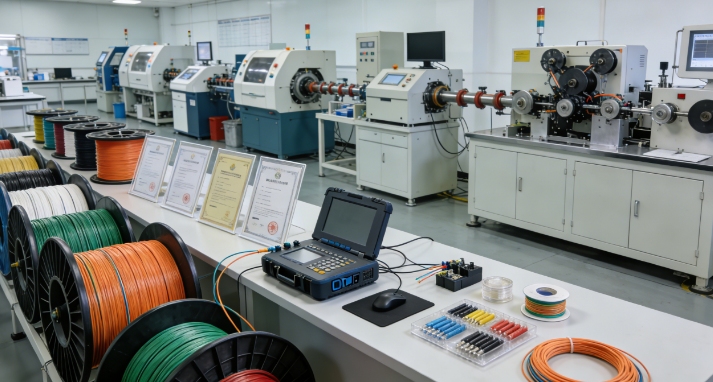
- Production Equipment and Processes: Top suppliers possess modern fiber drawing machines, coating machines, and fully automated production lines to ensure precision and consistency in every cable.
- R&D Capabilities: Suppliers possessing a professional R&D team are able to continuously enhance cable performance, ensuring it meets the demands of high-speed broadband and complex installation environments.
- Stable Production Capacity: Understand the supplier’s monthly output and delivery schedules to avoid project delays due to insufficient production.
These evaluations help determine whether FTTH cable suppliers are reliable for long-term cooperation.
3. Sample Testing and On-Site Inspection
An important step in verifying FTTH cable product quality is sample testing and on-site inspection.
- Optical Performance Testing: Use OTDR (Optical Time-Domain Reflectometer) or optical power meters to test fiber attenuation and return loss, assessing transmission stability.
- Environmental Adaptability Tests: Simulate high/low temperature, humidity, and mechanical stress conditions to check cable durability and tensile strength.
- Practical Deployment Tests: Lay a small amount of cable in the actual project environment to observe signal stability, connector compatibility, and ease of installation.
These methods allow you to evaluate whether the products provided by FTTH cable suppliers meet project requirements from a practical performance perspective.
4. Review Supplier Reputation and Customer Feedback
A supplier’s market reputation and customer feedback are also important references for verifying product quality.
- Customer Case Studies: Review the projects completed by the supplier to understand how their cables perform in different environments and scales.
- Third-Party Reviews: Check feedback from other clients on industry forums, B2B platforms, or social media.
- After-Sales Service: High-quality FTTH cable suppliers offer fast-response support, including warranties, technical consultations, and replacement services, reflecting confidence in their products.
By gathering information through multiple channels, you can avoid suppliers with potential quality risks.
Conclusion
In conclusion, verifying the quality of products from FTTH cable suppliers requires considering certifications, production capacity, sample testing, and supplier reputation. Through systematic inspections and practical testing, you can ensure the purchased cables meet high-speed transmission and long-term stability requirements. When selecting suppliers, it is important not only to focus on price but also on product quality and service assurance, ensuring smooth network deployment and reducing future maintenance costs. By following these methods, you can effectively identify reliable FTTH cable suppliers and achieve high-quality fiber optic installations.
0