



Table of Contents
Aerial roots are one of the most distinctive and admired features of a Ficus bonsai. They add a sense of age, strength, and natural beauty to the miniature tree. However, many growers struggle with the development of aerial roots ficus bonsai, often finding that roots fail to grow, grow weakly, or stop developing altogether. Understanding the underlying reasons behind this issue is essential to correcting care practices and encouraging healthy aerial root formation. In this article, we will look into the most common causes and offer practical solutions to help your bonsai flourish.
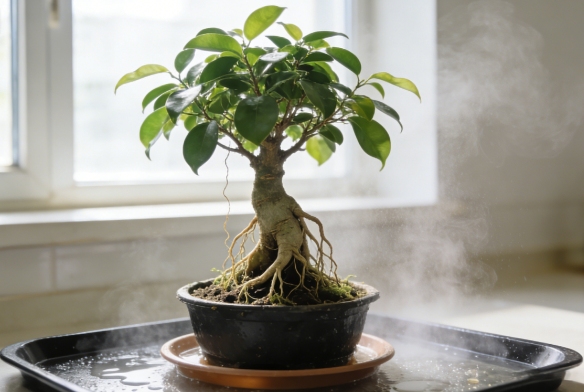
Improper Humidity Levels
Humidity plays a crucial role in the growth of aerial roots ficus bonsai. These roots naturally develop in tropical environments where the moisture in the air is consistently high.
- Low humidity conditions: When the air is too dry, aerial roots struggle to emerge and often dry out before they can establish. Indoor environments with air conditioning or heating can significantly reduce humidity levels, negatively affecting growth.
- Inconsistent moisture: Fluctuating humidity can confuse the plant’s growth signals. If the air alternates between dry and humid, the bonsai may fail to commit energy to aerial root formation.
- Solution approach: Increasing humidity through misting, using a humidity tray, or placing the bonsai in a controlled environment such as a greenhouse can encourage steady aerial root development.
Insufficient Light Exposure
Light is another essential factor influencing the growth of aerial roots ficus bonsai. Without adequate light, the plant cannot produce enough energy to support new root structures.
- Low light intensity: If the bonsai is placed in a dim area, it will focus on survival rather than growth, limiting aerial root production.
- Lack of direct sunlight: While indirect light can sustain the plant, insufficient direct or bright light reduces the chances of strong aerial root formation.
- Artificial lighting issues: Poor-quality artificial lights may not provide the full spectrum required for healthy growth.
- Recommended practice: Position the bonsai near a bright window or provide grow lights to ensure consistent and sufficient light exposure.
Incorrect Watering Practices
Watering habits directly affect the health of aerial roots ficus bonsai. Both overwatering and underwatering will hinder the growth and development of the root system.
- Overwatering problems: Excess water can lead to root rot, weakening the entire plant and inhibiting aerial root formation.
- Underwatering effects: If the soil becomes too dry, the plant conserves resources and halts aerial root growth to survive.
- Poor drainage: Soil that retains too much water can suffocate roots and prevent oxygen exchange.
- Balanced care tips: Maintain a consistent watering schedule, allowing the top layer of soil to dry slightly before rewatering, and ensure the pot has proper drainage.
Lack of Proper Environmental Conditions
Aerial roots ficus bonsai thrive in environments that closely mimic their natural tropical habitat. When conditions are not suitable, root development may be delayed or stopped.
- Temperature fluctuations: Sudden temperature changes can stress the plant, reducing its ability to produce aerial roots.
- Draft exposure: Placement near windows, air vents, or fans can create unstable air conditions that discourage root growth.
- Insufficient airflow: While still air can help retain humidity, completely stagnant air may lead to mold or poor plant health.
- Ideal environment setup: Maintain a warm, stable environment with gentle airflow to support consistent development.
Nutrient Imbalance and Soil Quality
Soil composition and nutrient availability are often overlooked but play a vital role in aerial roots ficus bonsai growth.
- Nutrient deficiency: Lack of essential nutrients, such as nitrogen, can limit overall growth, including aerial roots.
- Poor soil structure: Compact or dense soil restricts root expansion and reduces oxygen availability.
- Excessive fertilization: Over-fertilizing can damage roots and create imbalances that inhibit growth.
- Soil optimization: Use well-draining bonsai soil and apply balanced fertilizer in appropriate amounts to support healthy development.
Incorrect Pruning and Training Techniques
How you prune and train your ficus bonsai can significantly influence the development of aerial roots ficus bonsai.
- Over-pruning: Excessive trimming reduces the plant’s ability to allocate energy toward aerial root growth.
- Improper shaping: Cutting branches incorrectly may remove nodes where aerial roots could form.
- Lack of structural guidance: Without proper training methods, such as wrapping or supporting roots, aerial roots may not develop in the desired direction.
- Best practices: Prune carefully, allow natural growth patterns, and use training techniques to guide aerial root formation.
Conclusion
The development of aerial roots ficus bonsai depends on a combination of environmental conditions, care practices, and proper maintenance techniques. Factors such as humidity, light, watering habits, temperature, soil quality, and pruning all play a role in whether your bonsai produces healthy aerial roots. By identifying and correcting the issues outlined above, you can create an optimal environment that encourages strong and beautiful aerial root growth. With patience and consistent care, your bonsai can develop the striking aerial root structure that makes it truly exceptional.
0