
Table of Contents
With the rapid development of Industry 4.0, smart manufacturing, and digital factories, manufacturers are facing higher demands for automation systems. Production processes now require not only faster speeds but also greater precision, operational stability, and production flexibility. In this context, the motion control system has become a core technology in modern industrial automation. By precisely controlling mechanical motion, motion control systems help manufacturers achieve higher levels of automation and intelligence in their production processes.
What Is a Motion Control System?
A motion control system is an integrated solution designed to precisely control the position, speed, acceleration, and torque of mechanical equipment. A complete motion control system typically consists of a motion controller, servo motors or stepper motors, drives, feedback devices such as encoders, and dedicated software.
In industrial automation applications, these components work together through high-speed communication and closed-loop control, enabling machines to execute complex motion tasks accurately and consistently to meet high-precision and high-repeatability production requirements.
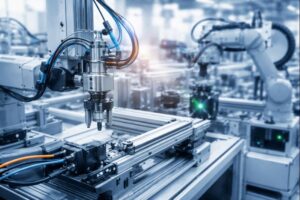
The Core Role of Motion Control Systems in Industrial Automation
1. Improving Production Accuracy and Consistency: In industrial automation, product quality and consistency are critical to a company’s competitiveness. A motion control system uses high-resolution feedback devices and advanced control algorithms to precisely regulate motion position and speed, ensuring that every machining or assembly operation follows predefined parameters.
This high level of accuracy minimizes mechanical deviations and human inconsistencies, helping maintain uniform product quality across large-scale production runs.
2. Increasing Production Efficiency: A motion control system features fast response times and high-speed processing capabilities, significantly reducing cycle times and equipment idle periods. In automated production lines, the system can optimize motion profiles according to production takt times, allowing machines to operate at higher speeds without compromising accuracy.
In addition, multi-axis synchronization and coordinated motion enable complex processes to be completed simultaneously, further improving overall production efficiency.
3. Supporting Complex Automation Applications: As industrial automation continues to advance, motion requirements are becoming increasingly complex. A motion control system supports advanced trajectory planning, multi-axis coordination, and real-time control adjustments, making it ideal for applications such as robotics, CNC machines, and high-end automated assembly systems.
Through flexible parameter settings and software-based control, motion control systems can quickly adapt to different products and process requirements, supporting flexible and scalable manufacturing.
How Does a Motion Control System Reduce Production Costs?
A high-performance motion control system not only improves machine capability but also helps reduce long-term operating costs:
- Reducing scrap rates:
By precisely controlling position, speed, and torque, a motion control systemsignificantly reduces process deviations and errors. Through real-time feedback and closed-loop control, every motion follows defined parameters, minimizing dimensional inaccuracies and assembly defects. This stable and repeatable performance reduces scrap and rework, helping manufacturers save raw materials and improve overall yield. - Reducing dependence on manual labor:
As motion control systems are widely adopted in industrial automation, reliance on manual operation is greatly reduced. The system can automatically execute complex and repetitive motion tasks based on predefined programs, minimizing uncertainty caused by human intervention. Higher automation levels lower labor costs and reduce the risk of human error, resulting in more stable and predictable production. - Reducing equipment maintenance costs:
A reliable motion control systemprecisely manages equipment operation, preventing excessive impact, overload, or unbalanced motion that can cause mechanical wear. Smooth motion profiles and optimized control strategies extend the service life of critical components and reduce failure rates. As a result, maintenance requirements and unplanned downtime are significantly reduced over the long term.
The Value of Motion Control Systems Across Different Industries
Motion control systems are widely used across various industries, delivering significant value in each. In industrial robotics and automated production lines, motion control systems ensure precise and coordinated machine movements. In semiconductor and electronics manufacturing, their high-precision capabilities meet strict requirements for micro-scale processing and consistency.
Additionally, in CNC machining, metal fabrication, packaging, printing, and logistics automation are involved. Motion control systems help improve productivity, optimize process flows, and drive the transition toward smarter and more efficient manufacturing operations.
Conclusion
In summary, a motion control system plays a critical role in improving industrial automation by enhancing precision, increasing efficiency, supporting complex applications, and reducing overall production costs. It is not only a foundational technology for high-quality manufacturing but also a key enabler for digital transformation and smart factory development. For manufacturers seeking to remain competitive in a rapidly evolving market. Selecting and implementing the right motion control system is a vital step toward achieving advanced industrial automation.
0