

Table of Contents
Artificial intelligence is changing the way we perform our tasks, and this technology is used to automate various routine processes and increase productivity. There are many ways in which AI can be used to automate our work – content generation, communication management, data analysis, and project management, for example.
Research shows that workflow automation can save up to 20% to 40% of the time spent on routine tasks, depending on the complexity of business processes. The right AI tools will not only help people and companies increase efficiency but also avoid mistakes.
Why AI Automation Tools Improve Daily Workflows
Saving Time on Repetitive Tasks
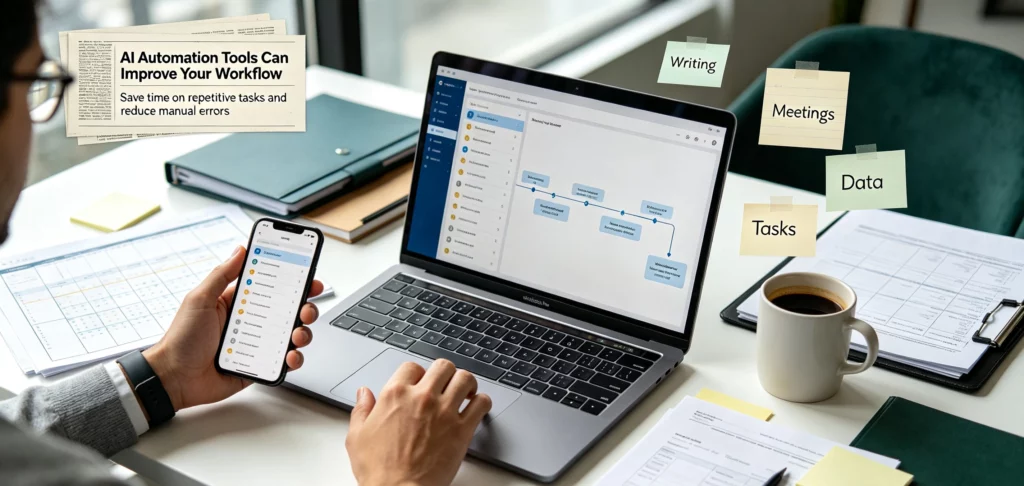
However, many tasks that we perform every day, including email sorting, report preparation, meeting scheduling, and data migration from one platform to another, are rather time-consuming but do not require any creative thinking. AI solutions allow these tasks quicker with the help of machine learning and natural language processing.
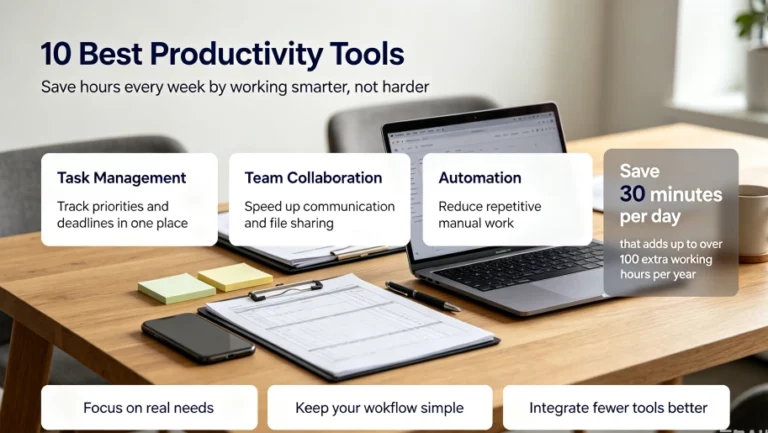
As another example, assuming an employee saves even half an hour per day through automation, the employee will have more than 120 hours to engage in innovative work in a year’s time.
Increasing Accuracy and Workflow Consistency
Manually processed systems can produce many mistakes, particularly when processing a huge amount of data. AI automations ensure consistency of the process by adhering to predetermined rules and analyzing data effectively.
Common benefits include:
- Automated data processing with fewer human errors
- Faster document creation and organization
- Improved communication management
- Real-time workflow tracking and analysis
Main Types of AI Automation Tools
Different AI solutions are designed for different productivity challenges. The following categories are commonly used across industries.
| Tool Type | Main Functions | Applications |
| AI Writing Tools | Content creation, editing, summarization | Articles, emails, reports |
| Workflow Automation Platforms | Connecting software and automating tasks | Data transfer, notifications |
| AI Meeting Assistants | Transcription and summary generation | Online meetings, collaboration |
| AI Project Management Tools | Task planning and tracking | Team workflows |
| AI Data Analysis Tools | Data processing and insights | Business decisions |
AI Automation Tools for Better Productivity
AI Writing and Content Tools
Writing software based on artificial intelligence technology is now widely used to enhance the process of writing content. These tools help create drafts, make summaries, correct grammar mistakes, and rewrite texts in various styles.
A professional content writing workflow should include AI support and human editing:
1. Create a first draft using AI
2. Improve the draft by checking its accuracy and structure
3. Apply professional views and knowledge of the industry
4. Get ready to publish the content
Workflow Automation Platforms
Workflow automation platforms allow users to connect different applications and create automatic processes without advanced coding skills.
For instance, companies can use AI to streamline workflows and automate tasks such as:
- Adding customer information to databases
- Sending notifications to team members
- Creating automatic follow-up emails
- Generating regular performance reports
These solutions are particularly useful for companies that rely on multiple digital tools because they reduce manual data transfers.
AI Meeting Assistants
Thanks to the rise in remote and hybrid work, AI-based meeting assistants have become productive tools for people’s use. The AI assistant can transcribe conversations and highlight all major points of action.
It would take about 15 to 30 minutes more to organize notes manually after an hour-long meeting. An AI assistant will manage to perform the same work in a couple of minutes.
How to Choose an AI Automation Tool That Fits Your Needs
Identify Workflow Challenges
Before choosing an AI tool, users should understand which tasks create the biggest productivity problems.
Important questions include:
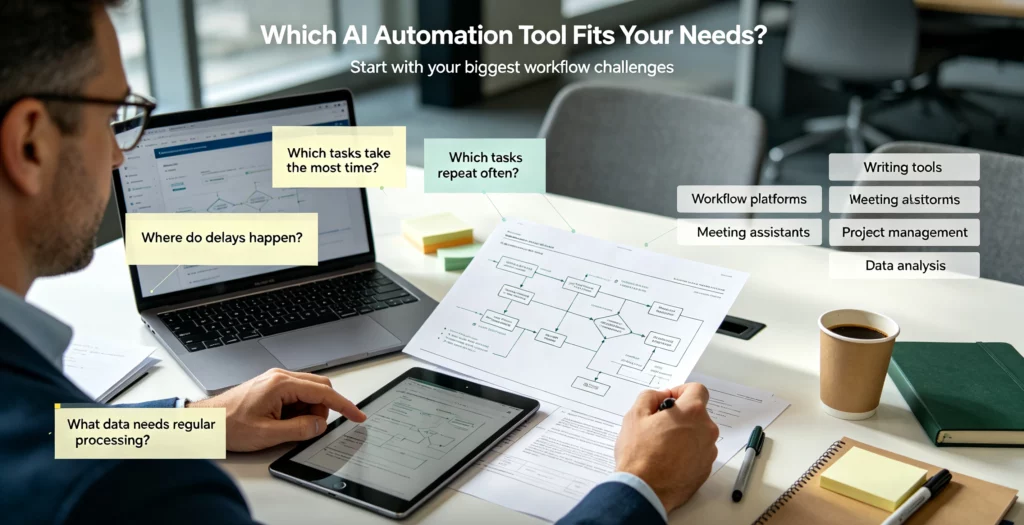
- Which activities consume the most working hours?
- Which tasks are repeated frequently?
- Where do workflow delays usually happen?
- What information requires regular processing?
Identifying these issues helps businesses select tools that provide real value instead of adding unnecessary complexity.
Check Integration and Scalability
A suitable AI automation tool should integrate with existing software systems and support future growth.
Key factors to consider include:
- Compatibility with current platforms
- Number of supported users
- Data security features
- Customization capabilities
A scalable solution can continue supporting workflow improvements as business requirements change.
Future Development of AI Automation
AI Agents for Automated Task Management
AI agents symbolize the coming wave of automation. While conventional devices only accomplish one task at a time, AI agents have the ability to evaluate objectives, devise a strategy, and execute several actions independently.
For instance, an AI agent could gather data, structure it, and generate a report all by itself with little help from humans.
More Intelligent Business Integration
The AI systems in the future will concentrate on integrating various tools within a common workflow environment to avoid switching between applications and offer more personalized solutions for increasing productivity.
At the same time, businesses will have to give more thought to securing their data, protecting their privacy, and the proper use of AI technologies.
Conclusion
The use of AI automation software is transforming workflows by minimizing manual tasks, increasing accuracy, and enabling efficient management of data. This can be seen from using AI writing assistants, workflow automation software, meeting applications, or data analysis software, which all represent concrete ways of increasing efficiency.
The best way to utilize this technology is to merge it with human abilities. This can be achieved by selecting software according to particular workflow needs.
0