


Table of Contents
A fiber access terminal is a device used in fiber-optic networks to manage the distribution of fiber signals to customers. It acts as the point where fiber-optic cables from the core network are split and connected to local distribution systems. This device helps distribute broadband internet, voice, and sometimes even video services to users, enabling the final connection from the network to the home or business.
What Role Does a Fiber Access Terminal Play in Fiber Networks?
A fiber access terminal serves as the intermediary between the high-capacity core fiber network and the users’ last-mile connections. Here’s a deeper look at the role it plays:
- Signal Distribution: It takes signals from the central fiber-optic backbone network and divides them into smaller, manageable channels that can be sent to individual homes or businesses.
- Management and Maintenance: The FAT simplifies maintenance and troubleshooting by allowing technicians to easily access and monitor fiber connections. It can house splice trays, splitting devices, and testing equipment.
- Cost Efficiency: In large-scale deployments, fiber access terminals help operators reduce installation costs by consolidating multiple connection points into a single unit.
For service providers, these terminals are key to ensuring that the infrastructure is scalable, easy to maintain, and capable of providing uninterrupted service to a growing number of users.
Types of Fiber Access Terminals
There are a few different types of fiber access terminals used in modern networks, each suited for different deployment needs:
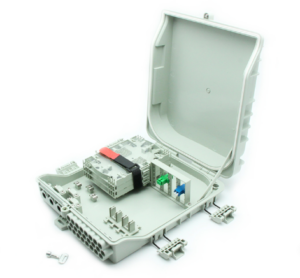
- Wall-mounted Fiber Access Terminals: These are typically used for residential applications where space is limited. They can be easily mounted on a wall and distribute fiber to multiple units in a building.
- Rack-mounted Fiber Access Terminals: Used in commercial or large-scale residential settings, these terminals are mounted in server racks and typically support a higher number of connections. They are designed for more complex installations and are commonly found in data centers or telecommunication hubs.
- Outdoor Fiber Access Terminals: These are weather-resistant units designed to be placed outside, often on poles or utility cabinets, to provide fiber access in rural or urban environments where underground installations may not be practical.
- In-line Fiber Access Terminals: These terminals are designed to be installed directly in the fiber cable line, providing a cost-effective solution for expanding networks and providing fiber connections in remote or hard-to-reach locations.
Why Are Fiber Access Terminals Essential in Today’s Network Infrastructure?
As the world shifts to faster and more reliable internet services, fiber-optic networks are quickly becoming the standard for broadband deployment. Here’s why the fiber access terminal is an integral part of this transition:
- Support for High-Speed Internet: Unlike traditional copper-based cables, fiber-optic cables have a much higher bandwidth capacity, which allows for faster internet speeds and higher data transmission. FATs ensure that these high-speed signals can be properly distributed and received without degradation.
- Scalability: One of the primary advantages of fiber-optic networks is their ability to support massive scalability. As more users are added to the network, the fiber access terminal can be expanded to accommodate new connections without needing a complete overhaul of the network. This makes it a future-proof solution for growing data demands.
- Increased Reliability: Fiber-optic connections are less prone to interference, weather damage, and signal degradation compared to traditional copper-based systems. By centralizing distribution at the fiber access terminal, service providers can reduce the number of points of failure in the network, improving reliability and uptime for customers.
Key Benefits of Fiber Access Terminals in Fiber Networks
- Better Signal Quality: Fiber-optic technology is known for its high bandwidth and low signal loss, which is ideal for high-demand applications like video streaming, gaming, and remote work. FATs ensure that these high-quality signals are maintained throughout the network.
- Simplified Network Management: By using fiber access terminals, network operators can easily manage and monitor the distribution of fiber signals. FATs allow for simpler maintenance and troubleshooting by consolidating the connections at one central point, making it easier to pinpoint issues and fix them quickly.
- Cost-Effective Installation and Maintenance: Deploying fiber networks can be expensive, but using fiber access terminals helps reduce costs by consolidating the number of required components. This means fewer installations are needed to provide service to large areas, ultimately reducing the upfront investment and maintenance costs for operators.
- Improved Performance for Customers: The use of FATs helps ensure that the end customer receives a fast, reliable, and consistent internet connection. Whether the user is in a residential neighborhood, a business district, or a rural area, a fiber access terminal can improve the performance of their broadband service.
Conclusion
Fiber optic access terminals are crucial for providing consumers and businesses with faster, more reliable internet access. As reliance on fiber optic networks grows, understanding the importance of fiber optic access terminals will help businesses and consumers better understand the technology behind high-speed internet connections.
0