

Table of Contents
A glasses free 3d display represents a major shift in how three-dimensional visuals are delivered to viewers, eliminating the need for head-mounted devices or special eyewear. Traditional 3D screens rely on glasses-based stereoscopic separation to trick the brain into perceiving depth, while newer systems aim to achieve the same effect directly through advanced optical engineering. The growing interest in immersive technologies has made the comparison between a glasses free 3d display and conventional 3D screens increasingly important, especially in fields such as entertainment, medical imaging, education, and industrial design. Understanding their differences requires examining how each system generates depth, handles viewing experience, and manages technical limitations.
Core Technology Differences in 3D Image Generation
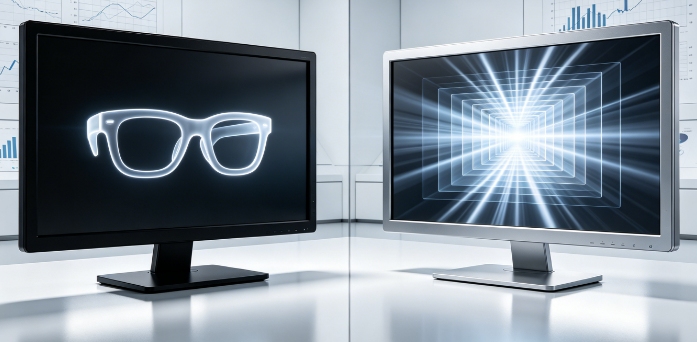
The most fundamental difference lies in how depth information is created and delivered to the human eye.
- Glasses-based 3D systems (conventional screens):
These rely on polarized lenses or active shutter glasses to separate left-eye and right-eye images. Each eye receives a slightly different frame, and the brain merges them into a 3D perception. The system depends heavily on external accessories. - Glasses free 3d displayapproach:
Instead of accessories, it uses optical structures such as lenticular lenses, parallax barriers, or light field projection to direct multiple image angles toward the viewer’s eyes. Depth perception is generated directly from the screen surface. - Rendering complexity difference:
Conventional systems usually require two synchronized images, while a glasses-free system may generate dozens of view angles simultaneously, increasing computational demand. - Dependency on hardware accessories:
One requires wearable devices; the other eliminates them, changing how users interact with 3D content.
This technological contrast defines the foundation of how both systems operate and deliver spatial visuals.
Viewing Experience and User Interaction Differences
User experience varies significantly between conventional 3D screens and a glasses free 3d display, especially in comfort and accessibility.
① Freedom of movement
With glasses-based systems, depth perception remains stable regardless of viewing angle. In contrast, glasses-free systems often rely on a “sweet spot,” where the 3D effect is most accurate, and may shift if the viewer moves too far.
② Comfort and long-term usage
Conventional systems may cause discomfort due to wearing glasses or flickering shutter effects. Glasses-free setups remove this burden, allowing longer viewing sessions with fewer physical constraints.
③ Multi-user experience
Traditional systems ensure all viewers see the same 3D effect. A glasses-free system can struggle with multiple viewers at different positions, sometimes offering inconsistent depth perception.
④ Ease of access and usability
No setup or wearable devices are required for glasses-free displays, making them more convenient for public installations like exhibitions or retail environments.
These differences highlight how interaction models vary depending on display technology.
Performance, Hardware, and Processing Requirements
Another major distinction lies in the hardware and computational demands required to support each system.
- Conventional 3D screens:
These systems typically require synchronized frame delivery and relatively moderate processing power since only two perspectives are generated. However, they depend on precise timing between the screen and glasses to avoid visual errors. - Glasses free 3d displaysystems:
These require significantly higher computational performance because multiple viewpoints must be rendered simultaneously. High-end GPUs or dedicated rendering chips are often necessary. - Latency sensitivity differences:
In conventional systems, latency is primarily managed between the screen and the glasses. In glasses-free systems, even slight delays can disrupt depth alignment and reduce realism. - Energy consumption considerations:
Multi-view rendering increases power usage, making glasses-free solutions more resource-intensive overall. - System scalability challenges:
Expanding screen size or resolution in glasses-free setups increases complexity exponentially compared to conventional 3D displays.
These factors demonstrate that while glasses-free systems offer convenience, they demand more advanced hardware support.
Application Scenarios and Industry Usage Differences
Both technologies are widely used, but their ideal applications differ based on performance needs and user environments.
- Entertainment and cinema:
Conventional 3D screens dominate movie theaters due to their stable depth perception across large audiences. However, glasses-free systems are emerging in gaming and personal entertainment devices. - Medical visualization:
A glasses free 3d display is increasingly used in surgical planning and diagnostic imaging, where hands-free interaction improves workflow efficiency. - Education and training:
Schools and simulation environments benefit from glasses-free systems because they reduce setup complexity and increase accessibility for students. - Retail and advertising:
Glasses-free displays are highly attractive in marketing environments, where passersby can immediately view 3D content without preparation. - Industrial design and engineering:
Both technologies are used, but glasses-free systems offer faster collaboration in real-time modeling sessions.
These differences show that each technology serves distinct user needs depending on context.
Conclusion
The key distinction between conventional 3D screens and a glasses free 3d display lies in how depth perception is delivered and experienced. Traditional systems rely on wearable devices and stable dual-image projection, ensuring consistent performance across viewers. In contrast, glasses-free technology eliminates accessories and creates a more natural interaction model, but introduces challenges such as viewing angle limitations and higher processing demands. As optical engineering and real-time rendering continue to advance, the gap between the two technologies is narrowing. Ultimately, the choice depends on whether priority is placed on stability and scalability or on convenience and immersive, device-free interaction.
0