
Table of Contents
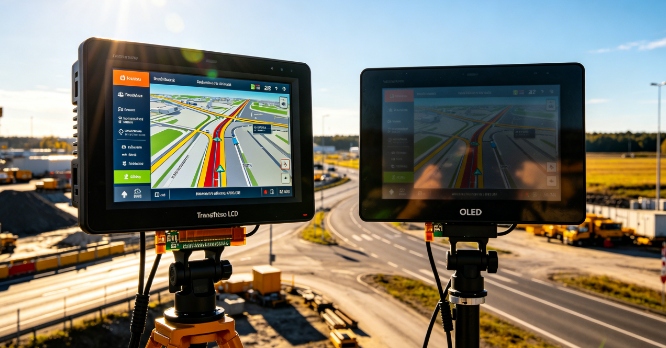
The transflective LCD is often compared with OLED technology in outdoor applications where sunlight readability, energy efficiency, and durability are important. OLED displays offer excellent contrast and image quality, but they may struggle under strong sunlight and consume more power at high brightness levels. In contrast, a transflective LCD is designed for outdoor visibility by combining reflective and transmissive technologies, making it more effective in bright environments.
Outdoor Visibility and Sunlight Performance Comparison
When it comes to outdoor environments, visibility is one of the most important factors determining display suitability.
- Sunlight readability advantage: A transflective LCD uses ambient light reflection to improve visibility, making it easier to read under direct sunlight.
- OLED brightness limitations outdoors: OLED screens rely heavily on self-emission of light, which can struggle against intense sunlight unless brightness is significantly increased.
- Performance Comparison: OLED displays exhibit superior contrast in low-light environments, whereas the transflective design maintains more consistent readability under bright conditions.
- Glare resistance performance: The reflective mechanism helps reduce washout effects that are often seen on OLED screens outdoors.
From a purely sunlight visibility perspective, the transflective LCD often performs better in extreme outdoor conditions.
Power Consumption and Efficiency in Field Use
Energy efficiency plays a key role in determining whether a display can be used in portable or outdoor devices for long periods.
Key efficiency comparison points include:
- Backlight usage vs self-emission
OLED pixels emit their own light, while transflective designs reduce backlight usage by relying on ambient light. - Daytime energy savings
In bright environments, a transflective LCD can significantly lower power consumption compared to OLED displays running at high brightness. - Battery impact in portable devices
Devices used outdoors for navigation, scanning, or monitoring may last longer with reduced backlight dependency. - Variable efficiency conditions
OLED can be efficient in dark environments, but outdoor sunlight often forces higher energy usage.
This makes the transflective LCD more energy-efficient in sustained outdoor usage scenarios.
Color Quality and Visual Experience Differences
While outdoor performance is important, visual quality also plays a major role in determining whether one technology can replace another.
- OLED color superiority: OLED displays deliver richer colors, deeper blacks, and higher contrast ratios, especially in controlled lighting conditions.
- Transflective LCD color trade-off: The reflective layer can slightly reduce color saturation and sharpness compared to OLED.
- Image consistency differences: OLED provides more uniform pixel-level lighting, while transflective screens balance between reflection and backlight.
- Application-based preference: OLED is generally favored for high-quality visuals and media consumption experiences.
These differences show that while the transflective LCD excels outdoors, OLED still leads in image quality.
Durability, Lifespan, and Environmental Suitability
Outdoor applications often require displays to withstand harsh conditions such as heat, dust, and continuous usage.
- Heat resistance advantage: Transflective designs typically generate less heat due to lower backlight usage in sunlight.
- Long-term stability: Reduced brightness stress can improve operational lifespan in outdoor equipment.
- OLED burn-in risk: OLED screens may suffer from image retention or burn-in during long static display use.
- Rugged application compatibility: Transflective LCDs are commonly used in industrial and field equipment due to their stable performance.
In demanding environments, the transflective LCD often provides better durability for continuous outdoor operation.
Application Scenarios and Practical Replacement Possibility
Whether one technology can replace the other depends largely on specific use cases rather than overall superiority.
- Industrial and field equipment: Transflective LCD is often preferred for GPS devices, scanners, and outdoor monitoring systems.
- Consumer entertainment devices: OLED dominates smartphones, tablets, and TVs due to superior visual performance.
- Transportation systems: Both technologies are used, but outdoor dashboards may benefit more from transflective designs.
- Hybrid design trend: Some manufacturers combine technologies depending on brightness requirements and device purpose.
This shows that replacement is not absolute; instead, each technology serves different application priorities.
Conclusion
The transflective LCD offers clear advantages in outdoor applications, particularly in sunlight readability, energy efficiency, and long-term stability under harsh conditions. Compared to OLED, it performs better in bright environments where visibility and power consumption are critical concerns. However, OLED still leads in color quality, contrast, and overall visual experience, making it more suitable for indoor and high-end consumer devices. Therefore, the transflective LCD cannot fully replace OLED across all applications, but it can outperform it in specific outdoor and industrial use cases. Ultimately, the choice between these technologies depends on whether the priority is outdoor readability and efficiency or premium visual performance.
0