



Table of Contents
In optical imaging systems, night vision devices, medical imaging equipment, and high-end display technologies, the fiber faceplate is a critical yet often underestimated component. Beyond serving as a simple light transmission medium, it plays a decisive role in preserving image details, maintaining contrast, and ensuring geometric accuracy. In high-resolution imaging systems, the performance of the fiber faceplate frequently becomes the limiting factor of the overall image quality. Therefore, understanding how a fiber faceplate affects image resolution is essential for proper system design and performance optimization.
What Is a Fiber Faceplate?
A fiber faceplate is an optical component formed by fusing tens of thousands to millions of micron-scale optical fibers into a solid plate with precise alignment. Each individual fiber consists of a core and cladding structure, enabling light entering the input surface to be transmitted directly to the corresponding position on the output surface with high positional accuracy. Thanks to this point-to-point transmission mechanism, a fiber faceplate can preserve the spatial structure of an image without relying on conventional lens-based imaging. This makes it particularly suitable for applications that demand extremely high geometric fidelity and stable image transfer.
Compared with traditional glass windows, a fiber faceplate offers several distinct advantages:
- Point-to-point image transmission
Each fiber acts as an independent optical channel, preventing image overlap and distortion while maintaining accurate spatial correspondence. - High contrast
Light is confined within individual fibers, significantly reducing stray light and improving overall image contrast. - Low crosstalk
Optical isolation between adjacent fibers minimizes signal interference, which helps preserve fine image details and sharp edges. - Capability for image inversion, scaling, or rotation
By employing tapered or twisted fiber faceplate structures, image processing functions can be achieved without introducing additional optical elements.
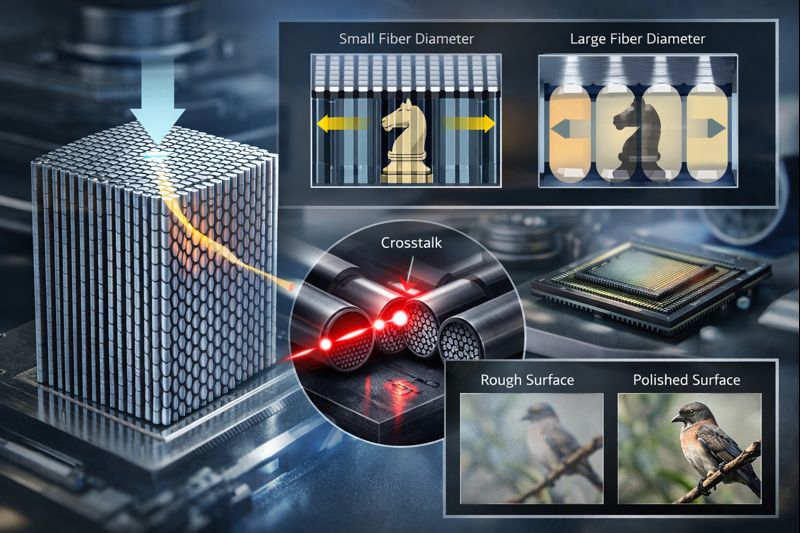
How Does Fiber Faceplate Affect Image Resolution?
1. Fiber Diameter Determines Theoretical Resolution
Fiber diameter is the most fundamental parameter governing the resolution of a fiber faceplate. Since each fiber functions as the smallest image sampling unit, its diameter directly defines the minimum resolvable feature size of the system.
- Smaller fiber diameters allow more fibers per unit area
A higher fiber density enables the system to sample finer image details, resulting in improved spatial resolution. - Higher packing density enhances image detail representation
Reduced spacing between fibers improves spatial continuity, leading to smoother edge transitions and clearer fine structures.
In practical terms, the resolution of a fiber faceplate can be approximated as being limited by the effective “pixel size” defined by the fiber diameter, similar to pixel-based digital imaging sensors.
2. Fiber Arrangement Structure Influences Image Sharpness
In addition to fiber size, the overall fiber arrangement structure has a direct impact on image sharpness and resolution. High-quality fiber faceplates typically adopt a regular hexagonal close-packed structure, which maximizes the filling factor and minimizes dead space.
If the fiber arrangement is irregular or contains defects such as broken fibers or uneven spacing, several image quality issues may arise:
- Localized image blur
Missing or misaligned fibers prevent complete signal transmission in certain areas, degrading local image clarity. - Non-uniform brightness
Inconsistent fiber distribution leads to uneven light output, which can negatively affect both visual quality and downstream image processing. - Reduced effective resolution
Structural inconsistencies disrupt spatial continuity, preventing the system from reaching its theoretical resolution limit.
As a result, manufacturing precision and structural consistency are essential to achieving high-resolution performance in fiber faceplates.
3. Impact of Crosstalk on Resolution
When optical isolation between neighboring fibers is insufficient, crosstalk occurs, allowing light to leak from one fiber into adjacent fibers. This phenomenon directly reduces edge contrast and causes fine details to appear blurred.
To suppress crosstalk, high-performance fiber faceplates typically incorporate the following design strategies:
- Use of high-absorption cladding materials
Absorptive cladding prevents leaked light from propagating into neighboring fibers. - Precise control of refractive index differences
Proper refractive index contrast strengthens total internal reflection, ensuring clean and confined light transmission.
Lower crosstalk results in sharper boundaries between adjacent image features, thereby improving effective resolution, especially in high-contrast imaging environments.
4. Surface Polishing Quality Affects Effective Resolution
Even if a fiber faceplate possesses excellent theoretical resolution, insufficient polishing quality on the input or output surfaces can significantly degrade actual image performance.
Poor surface finishing may lead to:
- Increased light scattering
Microscopic surface roughness causes non-ideal scattering, reducing image clarity and contrast. - Loss of fine structural information
High-frequency image details may be attenuated early in the transmission process, lowering effective resolution.
High-precision polishing minimizes surface defects and allows the fiber faceplate to operate closer to its design limits, substantially improving the system’s effective resolution.
Resolution Performance of Fiber Faceplate in Different Applications
- Night Vision and Image Intensification Systems
In image intensifiers, fiber faceplates are commonly used to couple the photocathode, microchannel plate, and phosphor screen. Their resolution directly determines the clarity of night vision images and the system’s target recognition capability.
- Medical Imaging Equipment
In X-ray imaging and endoscopic systems, fiber faceplates efficiently transmit weak optical signals. Higher resolution enables clearer visualization of fine tissue structures, supporting more accurate diagnosis and early disease detection.
- Industrial and Scientific Imaging
In precision inspection, semiconductor analysis, and scientific imaging, fiber faceplates help maintain geometric accuracy and stable resolution, ensuring reliable and repeatable measurement results.
Conclusion
The impact of a fiber faceplate on image resolution is multifaceted and highly interdependent. Fiber diameter, packing structure, crosstalk control, and surface polishing quality all contribute directly to final image performance. Only when these factors are optimized together can a fiber faceplate fully realize its high-resolution potential. For advanced imaging systems that demand superior image quality, selecting and optimizing the appropriate fiber faceplate has become a critical step in achieving competitive performance and long-term reliability.
0