



Table of Contents
In modern fiber optic communication systems, selecting the right fiber type directly affects network performance, cost, and scalability. Single-mode FTTH drop cable and multimode fiber are two commonly used options, but they are designed for very different applications, especially in FTTH (Fiber to the Home) deployments.
An inappropriate fiber choice can lead to limited transmission distance, reduced upgrade flexibility, and higher long-term operational costs. This article provides a clear comparison of single-mode FTTH drop cable and multimode fiber in terms of structure, transmission distance, application scenarios, cost considerations, and future bandwidth capability, helping ensure a reliable and scalable FTTH network design.
What Is Single-Mode FTTH Drop Cable?
A single-mode FTTH drop cable is a type of fiber optic cable specifically designed for FTTH access networks. Its primary function is to deliver optical signals from the service provider’s fiber distribution point, such as an ODF, FDB, or fiber distribution box, directly to the end user’s terminal equipment, including ONT or ONU devices.
In an FTTH network architecture, the drop cable represents the final connection segment between the network infrastructure and the subscriber. Because this section is installed close to users and buildings, it must offer reliable transmission performance, mechanical durability, and easy installation.
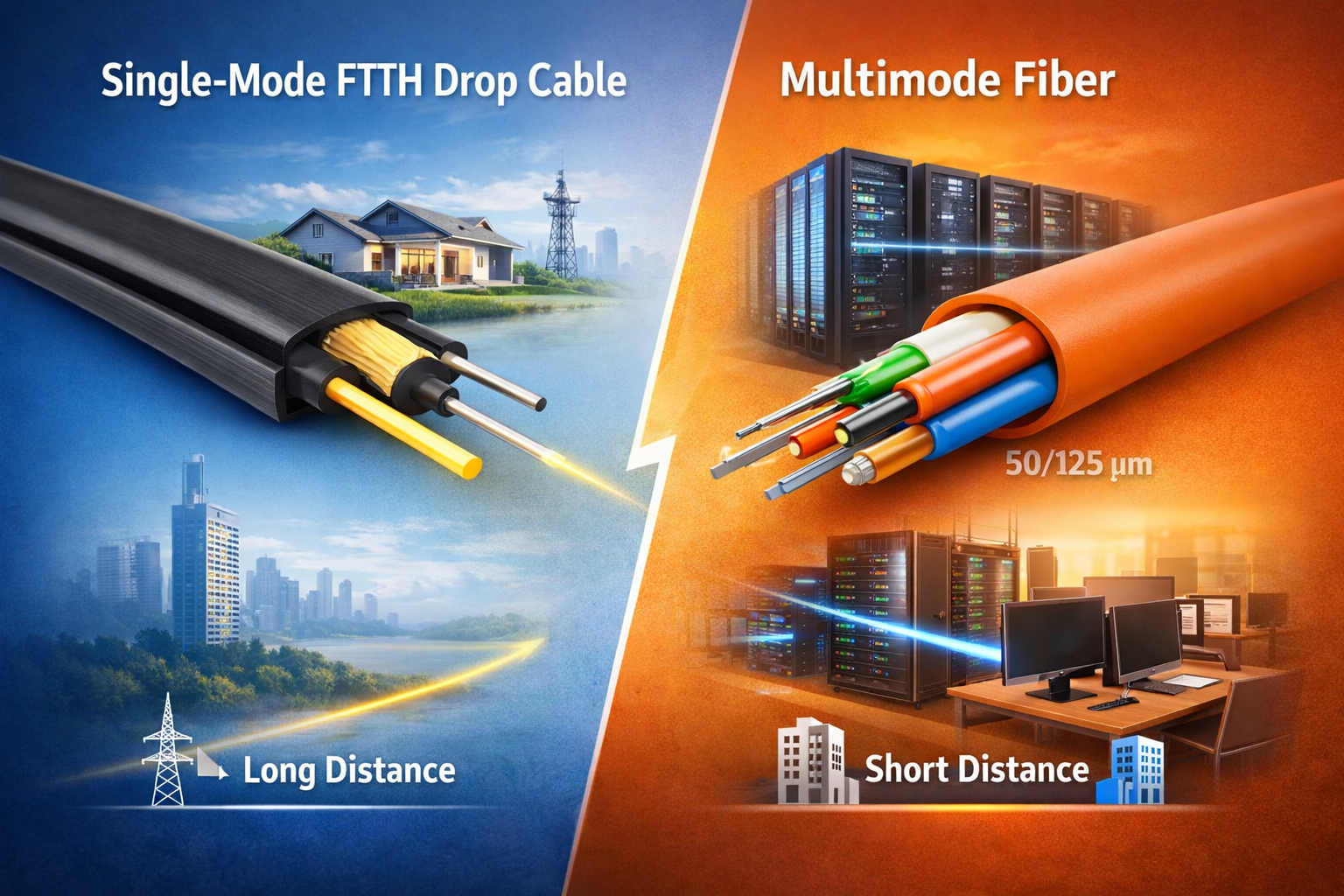
Key Characteristics:
- Uses single-mode fiber (SMF)
A single-mode FTTH drop cable is built with single-mode fiber, allowing light to travel through the fiber core in a single propagation mode. This significantly reduces signal distortion and ensures stable transmission over long distances. - Typical core size of 9/125 μm
This standard fiber specification is widely used in telecommunications networks and supports long-distance, high-speed optical transmission. - Supports long-distance and high-bandwidth transmission
Single-mode FTTH drop cable can maintain low attenuation even over tens of kilometers, making it ideal for FTTH access networks. - Compact structure suitable for indoor and outdoor routing
The cable jacket and reinforcement design provide flexibility and sufficient tensile strength, allowing installation in ducts, along walls, and into residential buildings. - Commonly designed as flat drop cable
The flat or butterfly structure makes the cable easy to fix, bend, and route, especially in last-mile FTTH installations.
For these reasons, single-mode FTTH drop cable has become the standard solution for FTTH deployments worldwide.
What Is Multimode Fiber?
Multimode fiber is a type of optical fiber that allows multiple light modes to propagate simultaneously through the fiber core. Due to its larger core diameter, light signals can follow different paths as they travel along the fiber.
Multimode fiber was originally developed to reduce coupling complexity and equipment costs, making it suitable for short-distance optical communication.
Key Characteristics:
- Larger core diameters such as 50/125 μm or 62.5/125 μm
The larger core makes it easier for light to enter the fiber but also increases the likelihood of modal dispersion. - Primarily used in LANs and data centers
Multimode fiber is commonly deployed for short-distance connections between switches, servers, and storage equipment. - Relatively limited transmission distance
As data rates increase, the maximum supported transmission distance of multimode fiber decreases significantly. - Mainly designed for indoor environments
Multimode fiber is rarely used in outdoor access networks or FTTH deployments.
Key Differences Between Single-Mode FTTH Drop Cable and Multimode Fiber
1. Transmission Mode
- Single-mode FTTH drop cable:
Only one light mode propagates through the fiber core, which minimizes modal dispersion and preserves signal quality over long distances. - Multimode fiber:
Multiple light modes propagate at the same time, and each mode travels a slightly different path, leading to modal dispersion and signal degradation.
2. Transmission Distance
- Single-mode FTTH drop cable:
In FTTH networks, single-mode fiber can easily support transmission distances of 10 km, 20 km, or even longer, depending on the optical equipment used. - Multimode fiber:
Typically supports transmission distances of only a few hundred meters in high-speed applications.
Because FTTH networks often require centralized equipment to serve users across wide geographic areas, transmission distance is critical, making single-mode FTTH drop cable the preferred choice.
3. Application Scenarios
| Type | Main Applications |
| single-mode ftth drop cable | FTTH networks, access networks, telecom operators |
| multimode fiber | Data centers, enterprise LANs, short-distance links |
In practical network design, FTTH projects almost exclusively use single-mode ftth drop cable rather than multimode fiber, due to coverage and scalability requirements.
4. Light Source and Equipment Cost
- Single-mode ftth drop cable
Typically used with laser-based light sources, such as laser diodes (LD), which provide high optical power and long transmission reach but come with relatively higher equipment costs. - Multimode fiber
Commonly paired with LED or VCSEL light sources, which are more cost-effective for short-distance communication.
However, in FTTH networks, long-term performance, reliability, and upgrade capability are more important than initial equipment cost.
5. Bandwidth and Future Scalability
- Single-mode FTTH drop cable:
Offers extremely high bandwidth potential and can support future upgrades from GPON to 10G PON, 25G PON, and beyond without replacing the fiber infrastructure. - Multimode fiber:
Has more limited bandwidth scalability, and higher transmission speeds significantly reduce allowable distance.
From a long-term network planning perspective, single-mode FTTH drop cable provides a more future-proof solution.
Conclusion
Although multimode fiber continues to play an important role in data centers and short-distance optical communication, it is not well suited for FTTH access networks due to its limited transmission distance and scalability. In contrast, single-mode FTTH drop cable offers superior transmission performance, network stability, and long-term upgrade potential. For any project involving FTTH access, residential broadband deployment, or telecom network construction, choosing single-mode FTTH drop cable is not only the most practical solution today but also the most reliable investment for the future.
0