


Table of Contents
The cost of a robotic arm can vary significantly depending on its application, payload capacity, precision level, software system, and level of automation. In modern industry, robotic arms are widely used in manufacturing, logistics, electronics assembly, welding, packaging, and even medical operations. Because of this wide range of applications, pricing is not fixed and can range from a few thousand dollars for basic educational models to over one hundred thousand dollars for advanced industrial systems. When working with different robotic arm manufacturers, buyers will notice that pricing is influenced not only by hardware specifications but also by customization, control systems, and after-sales support. Understanding the cost structure helps businesses make more informed investment decisions.
Entry-Level Robotic Arm Cost Range
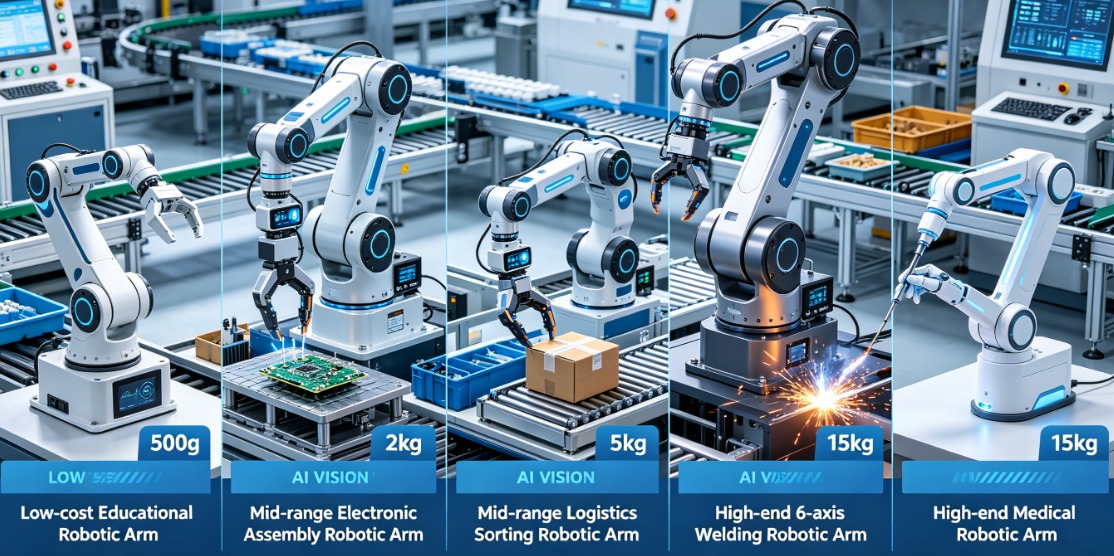
Basic robotic arms are designed mainly for education, light automation, or small-scale tasks.
- Low-cost training models
These typically range from $1,000 to $10,000 and are used in universities or training centers to teach robotics programming and basic automation concepts. - Limited payload capacity
Most entry-level arms can only handle lightweight objects, usually under 5 kg, making them unsuitable for heavy industrial tasks. - Basic control systems
They often use simple programming interfaces or manual control systems, without advanced AI or machine vision integration.
Industrial Robotic Arm Pricing Factors
Mid-range industrial robotic arms are widely used in factories and production lines, and their pricing depends on multiple technical factors.
- Payload and reach capability
Higher payload capacity (10–50 kg or more) increases cost because stronger motors and reinforced mechanical structures are required. - Precision and repeatability
Applications like electronics assembly require extremely high precision, which increases the cost due to advanced servo systems and calibration technology. - Integration with automation systems
Robots that can integrate with sensors, conveyors, and smart factory systems are more expensive because they require advanced software and control architecture.
High-End Robotic Arm Systems
Advanced robotic arms used in aerospace, automotive welding, and medical surgery represent the highest price range.
- AI and machine vision integration
These systems can detect objects, adjust movements in real time, and perform complex tasks autonomously, significantly increasing system cost. - Multi-axis flexibility
6-axis or 7-axis robotic arms provide human-like movement, allowing them to operate in complex environments with high efficiency. - Customized engineering solutions
Many high-end systems are fully customized based on industrial requirements, which increases development and production costs significantly when working with premium robotic arm manufacturers.
Additional Cost Considerations Beyond Hardware
The total investment in a robotic arm system includes more than just the purchase price.
- Installation and integration costs
Setting up a robotic system often requires engineering support, factory layout adjustment, and software configuration. - Maintenance and spare parts
Regular servicing, lubrication, sensor calibration, and component replacement add to long-term operational expenses. - Training and software updates
Operators need training to use the system efficiently, and ongoing software upgrades may be required to maintain performance.
Key Factors That Influence Robotic Arm Pricing
Several technical and business factors directly affect how much a robotic arm will cost in real-world applications.
- Application industry type
Manufacturing, logistics, medical, and electronics industries all require different levels of precision and durability, which impact cost. - Level of automation required
Fully automated systems cost more than semi-automated or manually assisted robotic arms. - Brand and manufacturer capability
Experienced robotic arm manufacturers often charge higher prices due to better reliability, advanced technology, and global service support.
Conclusion
The cost of a robotic arm depends on its complexity, application, and level of automation, ranging from a few thousand dollars for basic models to very high investments for advanced industrial systems. Factors such as payload capacity, precision, AI integration, and customization all play important roles in determining the final price. When evaluating options from different robotic arm manufacturers, businesses should consider not only the initial purchase cost but also long-term maintenance, integration, and operational efficiency. A well-chosen robotic system can significantly improve productivity, accuracy, and overall manufacturing competitiveness.
0