

Table of Contents
In the packaging industry, labeling technology plays a key role in product appearance, durability, and production efficiency. Two widely used methods are in mold labeling and pressure-sensitive labeling. While both are used to decorate plastic containers and packaging products, they differ significantly in how labels are applied, how they perform, and what benefits they offer. Understanding these differences is essential for manufacturers choosing the right solution for food packaging, cosmetics, household products, and industrial containers. As brands continue to demand higher quality packaging and faster production, comparing these two labeling methods becomes increasingly important for cost control, sustainability, and visual branding.
Application Process and Manufacturing Method Differences
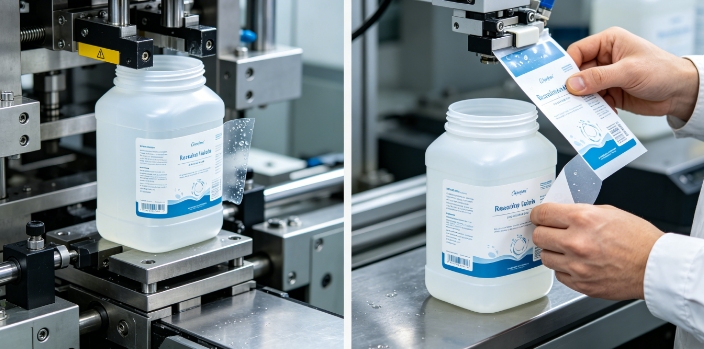
The most fundamental difference between these two technologies lies in how and when the label is applied during production. In mold labeling, the label is integrated directly into the plastic product during the injection molding process, while pressure-sensitive labeling is applied after the container is manufactured.
Key process differences include:
- In mold labeling, a pre-printed film is placed inside the mold before injection, allowing the label to fuse with molten plastic and become part of the final product.
- Pressure-sensitive labeling uses adhesive-backed stickers that are applied to finished containers after molding and cooling.
- The first method combines molding and decoration in one step, while the second requires a separate labeling stage.
- Automation is more common in in-mold systems, while pressure-sensitive labeling often requires additional mechanical or manual application equipment.
Because of these differences, production flow, equipment requirements, and labor needs vary significantly between the two methods.
Durability and Performance in Real-World Use
Durability is one of the most important factors when selecting a labeling solution, especially for products exposed to moisture, friction, or temperature changes. In mold labeling is generally considered more durable because the label is protected within the plastic surface.
Performance differences include:
- Labels are fully embedded into the container surface, preventing peeling, scratching, or bubbling.
- Resistance to water, oil, and chemicals makes it ideal for refrigerated food, cleaning products, and cosmetic packaging.
- Long-term storage does not affect print quality, ensuring branding remains clear throughout the product lifecycle.
- Pressure-sensitive labels may degrade over time, especially in humid or high-friction environments.
These characteristics make in-mold solutions more suitable for products requiring long-lasting visual integrity.
Visual Quality and Branding Impact
Packaging design plays a crucial role in shaping how consumers view a product and whether they choose to buy it. Both labeling methods can produce attractive packaging, but their visual results differ significantly in terms of consistency and premium feel.
- In mold labeling delivers seamless, edge-free decoration that fully wraps around the container surface.
- High-resolution printing allows for complex graphics, gradients, and multi-color branding designs.
- Surface finishes can be customized with matte, glossy, or textured effects to enhance brand image.
- Pressure-sensitive labeling may show edges, air bubbles, or misalignment if not applied precisely.
For premium product lines such as cosmetics, dairy products, and high-end beverages, the integrated look of in-mold decoration often provides a stronger shelf impact.
Production Efficiency and Cost Structure
Manufacturing efficiency is another major factor when comparing labeling technologies. Each method has different cost implications depending on production volume, automation level, and operational setup.
- In-mold labeling integrates labeling and molding into a single automated process, thereby reducing downstream production stages.
- It lowers long-term labor costs because fewer manual operations are required.
- High-speed production lines can increase output efficiency for large-scale manufacturing.
- Pressure-sensitive labeling requires additional equipment and handling after container production.
However, pressure-sensitive labeling may have lower initial setup costs, making it more flexible for small production runs or frequent design changes.
Environmental Impact and Material Usage
Sustainability has become a major concern for modern packaging industries. Companies are increasingly evaluating labeling methods based on environmental impact and recyclability.
In mold labeling offers several eco-friendly advantages:
- No extra adhesives are needed, which helps minimize chemical usage in the production process.
- Label and container can often be recycled together, simplifying waste processing.
- Fewer production steps result in lower energy consumption.
- Pressure-sensitive labels may introduce additional materials that complicate recycling processes.
These environmental benefits make in-mold technology more aligned with global sustainability goals and green packaging initiatives.
Conclusion
In summary, the main differences between in mold labeling and pressure-sensitive labeling lie in the application process, durability, visual performance, production efficiency, and environmental impact. While pressure-sensitive labeling offers flexibility and lower initial cost, in-mold technology provides superior durability, seamless aesthetics, and higher automation efficiency. For manufacturers focusing on long-term branding quality and large-scale production, in mold labeling is often the more advanced and reliable solution.
0