


Table of Contents
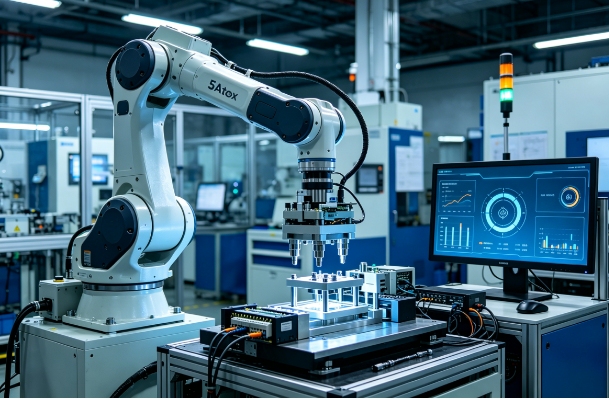
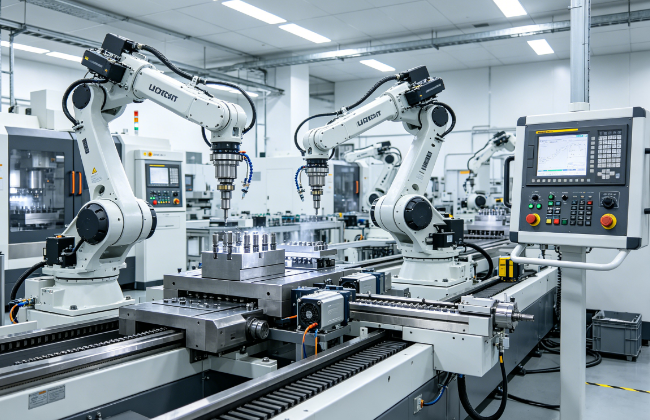
Industrial servo motors play a critical role in modern automation systems, especially in robotics and CNC (Computer Numerical Control) machines, where precision, speed, and reliability are essential. These motors are designed to provide highly accurate motion control, enabling machines to perform complex tasks with consistent repeatability. Unlike conventional motors, industrial servo motors use feedback systems to adjust position, speed, and torque continuously, ensuring optimal performance in dynamic working conditions. As manufacturing industries move toward higher levels of automation and smart production, the demand for advanced motion solutions continues to grow rapidly, making servo technology a core component in robotics and CNC applications.
High Precision and Motion Accuracy
One of the main reasons industrial servo motors are widely used is their exceptional precision:
- Closed-loop feedback control system
Servo motors continuously receive feedback from encoders, allowing real-time adjustments to maintain accurate positioning. This ensures that even the smallest movement is executed precisely as programmed. - Micron-level positioning capability
In CNC machining and robotic assembly, accuracy is critical. Servo systems can achieve extremely fine positioning, making them ideal for cutting, engraving, and assembly tasks that require high precision. - Consistent repeatability in operations
Industrial servo motors can repeat the same motion thousands of times without losing accuracy, which is essential for mass production environments. - Reduced mechanical deviation
Because motion is electronically controlled rather than purely mechanical, errors caused by wear and mechanical backlash are significantly minimized.
Superior Performance in Robotics Applications
Robotics heavily depends on stable and responsive motion systems:
- Smooth multi-axis coordination
Industrial servo motors allow robotic arms to move across multiple axes simultaneously with smooth synchronization, improving operational efficiency. - Fast response to dynamic tasks
Robots often perform pick-and-place or assembly operations that require instant motion changes. Servo motors respond quickly to control signals, enabling agile performance. - High torque at low speeds
In robotic joints, servo motors deliver strong torque even at low speeds, ensuring stable lifting and precise manipulation of objects. - Adaptability to complex programming
Robotic systems require flexible motion paths. Servo-driven systems can easily adjust to different tasks through software-based control.
Essential Role in CNC Machine Performance
CNC machines rely heavily on precision motion systems for manufacturing processes:
- Accurate tool positioning
Industrial servo motors control the movement of cutting tools with extreme accuracy, ensuring precise shaping of metal, wood, or plastic materials. - Stable cutting speed control
Maintaining consistent speed during machining improves surface quality and reduces material waste. - Multi-axis synchronization for complex shapes
CNC machines often require simultaneous movement across X, Y, and Z axes, which servo systems manage efficiently. - Reduced machining errors and rework
High precision reduces defects in finished products, improving overall production efficiency and lowering costs.
Efficiency, Reliability, and Industrial Benefits
Beyond precision, servo systems offer several operational advantages:
- Energy-efficient operation under variable loads
Servo motors adjust power consumption based on workload, improving energy efficiency in industrial environments. - Long service life with minimal maintenance
Due to their durable design and reduced mechanical friction, industrial servo motors require less maintenance compared to traditional systems. - Stable performance in continuous production
They are designed for 24/7 operation, making them suitable for large-scale manufacturing facilities. - Improved production speed and output quality
Faster response and precise control lead to higher throughput without sacrificing quality.
Integration with Modern Automation Systems
Industrial automation relies on seamless system integration:
- Compatibility with PLC and motion controllers
Servo systems can easily integrate with programmable logic controllers for centralized automation control. - Advanced software programming support
Modern servo systems support complex motion programming, allowing engineers to design efficient production workflows. - Real-time monitoring and diagnostics
Built-in monitoring systems help detect faults early and maintain stable operation. - Scalability for different industrial applications
From small robotic arms to large CNC machines, servo systems can be scaled according to production requirements.
Conclusion
In conclusion, industrial servo motors are widely used in robotics and CNC machines due to their unmatched precision, fast response, and reliable performance. Their ability to provide accurate motion control, support complex automation tasks, and maintain stability under continuous operation makes them essential in modern manufacturing. As industries continue to advance toward intelligent production systems, industrial servo motors will remain a key technology driving efficiency, accuracy, and innovation in robotics and CNC machining applications.
0